
Executive Insights · Carbon Advisory & MRV
Abu Dhabi MRV Reporting: A Guide by Cosmos Energy Intelligence
Cosmos Energy Intelligence
Engineering and Carbon Advisory · UAE & GCC
Published: 28 October 2026 | Last Updated: 28 October 2026
Direct Answer and Strategic Summary
How can a facility prepare for MRV reporting?
Confirm the facility boundary and applicable reporting requirements, map emission sources, collect traceable records, document the monitoring method and review the evidence before submission. Keep inventory preparation, internal quality checks and independent verification as distinct responsibilities.
Facility emissions reporting is easier to manage when the site boundary, source records and review responsibilities are clear from the start. Cosmos Energy Intelligence helps facility teams define the advisory scope for organising this information and preparing for an independent review.
Confirm the facility boundary and current applicability
Begin by confirming which facility, activities and reporting period the exercise covers. Applicability can depend on location, sector, emissions and current authority instructions. Record the basis for the decision before completing a reporting workbook; a corporate sustainability target alone does not define a facility reporting boundary.
Start by recording the operator, site, activities and reporting period. Ask the responsible environmental lead to confirm the current scheme requirements and any facility-specific correspondence. Retain that decision with the evidence used to make it. A consultant can help assemble the screening information; the operator remains responsible for its submission.
Separate facility MRV from the corporate carbon inventory
Facility emissions reporting and a corporate Scope 1, 2 and 3 inventory can have different boundaries and purposes. Distinguish direct emissions from purchased-energy and value-chain emissions. Purchased electricity and district cooling should not be inserted into a direct-emissions total merely because their bills are readily available.
Keep a mapping between facility records and the wider corporate inventory. Record what is included, excluded and shared, together with the reason. This makes it easier to reuse evidence without presenting two different totals as though they measure the same thing.
Build an evidence register before completing the workbook
A practical evidence register connects every source to an owner, measurement or calculation method, period, unit and supporting record. Include the facility description, source streams, calculation factors, measurement systems, data gaps and quality controls. Each reported total should be traceable to both a documented method and the records used to apply it.
- Give each source a stable identifier and connect it to the relevant equipment or process.
- Link fuel quantities to invoices, delivery records, stock movements and meter readings where available; investigate differences.
- Record instrument identifiers, calibration evidence, factor sources, versions and unit conversions.
- Keep a data-gap log showing the affected period, proposed treatment, reviewer and unresolved evidence.
Keep the monitoring plan and annual emissions report distinct
The monitoring plan describes how the facility will identify, measure, calculate and control its emissions data. The annual emissions report applies that approach to the reporting period. Internal checking helps prepare both documents for review; it does not provide an independent verification opinion.
For preparation, use a controlled working copy and preserve the original template. Do not replace missing readings with zero or silently overwrite formulas. Record changes, assign a reviewer and reconcile the period covered by the source records with the period used in the calculation. Agree how corrections and version approval will be documented.
A practical readiness sequence
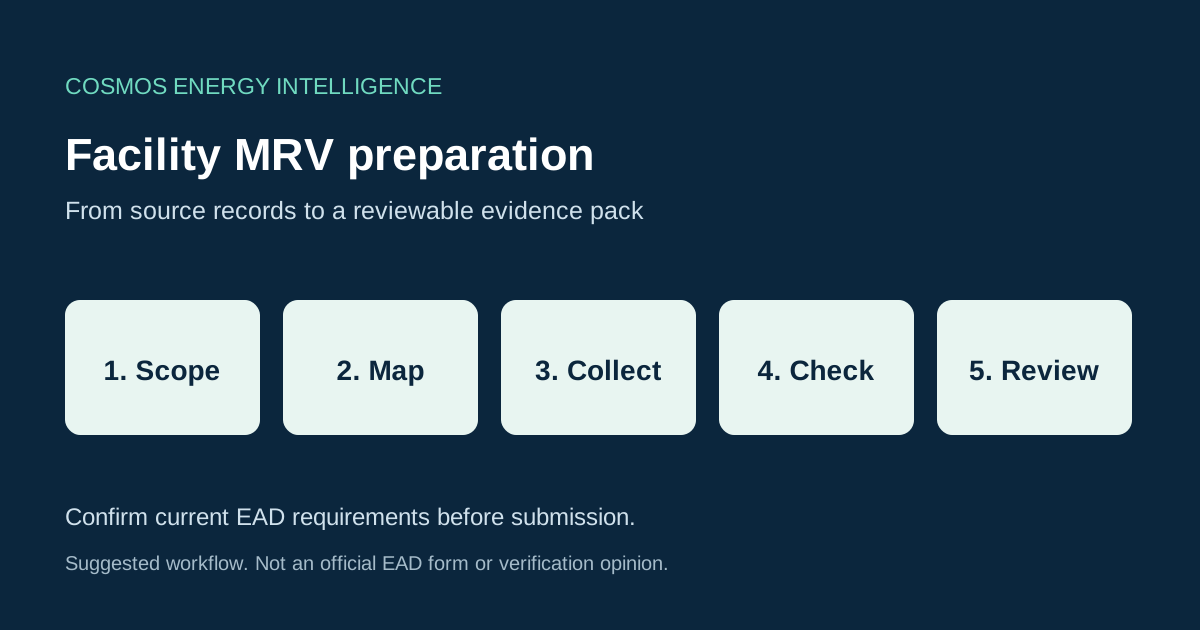
The following sequence is a suggested working method for the facility team. It is not an official filing form or a substitute for EAD instructions.
- Scope: agree the site boundary, operator, reporting period and current applicability.
- Map: walk through the activities and list sources, meters and record owners.
- Collect: build an evidence index and request missing records before calculating totals.
- Check: review units, factors, duplicated sources, missing periods and reconciliations.
- Review: approve the working inventory and monitoring narrative, then prepare the evidence requested for independent verification.
Resolve uncertainties before handover
Common preparation problems include mixing facility and group boundaries, using an undocumented factor, reporting a meter total twice, and treating an estimate as measured data. Record each open point with its impact, owner and next action. A concise unresolved-items list is more useful to a reviewer than a completed-looking workbook that hides uncertainty.
Confirm the current requirements for the independent verifier, including the relevant registration, accreditation and independence arrangements. Agree the handover evidence and review responsibilities early. A completed workbook or an internal quality check does not, by itself, establish regulatory acceptance or fulfil a separate verification requirement.
How Cosmos can support the preparation
Cosmos can discuss a defined advisory scope for source mapping, inventory calculations, evidence indexing, monitoring-plan drafting and preparation for an independent review. A useful initial discussion identifies the facility, reporting objective, available records and internal decision owner.
Agree the deliverables and responsibilities before starting: for example, a source register, calculation workbook, evidence index, monitoring narrative and open-items list. Independent verification opinions, regulatory acceptance and certification decisions require the appropriate responsible parties. This article does not claim that Cosmos is an EAD-accredited verifier or that an enquiry guarantees compliance.
Confirm the current reporting requirements, dates, templates and verification arrangements applicable to your facility before submission.
Frequently Asked Questions
Is an energy audit the same as facility emissions MRV?
No. An energy audit investigates energy use and improvement opportunities. Facility emissions MRV documents emissions within the applicable reporting boundary. They can share operational evidence, but their totals, methods and deliverables serve different purposes.
What should we prepare for an initial discussion?
Share the facility type, reporting objective, period and the kinds of records available. A list of meters, fuels and responsible staff is useful. Send confidential operating files only after agreeing a suitable document-sharing process.
Does completing a template provide independent verification?
No. Data preparation and internal checks support review. An independent verification opinion is a separate engagement, subject to current requirements for the verifier and its independence.