
Protocol reference: EVO IPMVP Core Concepts (EVO 10000-1; the DoE protocol cites the 2016 edition). Use the edition agreed in the project M&V plan.
1. The Opportunity in Commercial Cooling
Across the UAE commercial built environment—encompassing premium office towers, luxury hotels, healthcare campuses, and retail malls—cooling represents both the single largest operational expenditure and the greatest opportunity for net operating income (NOI) expansion.
Cooling can be a major electrical load in UAE buildings, but its share depends on building use, climate, occupancy and equipment. Establish the site-specific HVAC share from submeters and utility records before selecting measures or forecasting savings.
2. What an Engineering-Led Audit Examines
A true engineering-led audit goes far beyond reviewing equipment nameplates or utility bills. Guided by rigorous thermodynamic principles, the audit evaluates five interconnected operational layers:
- Utility and Climate Baseline: 24 to 36 months of interval energy meter data correlated against local Cooling Degree Days (CDD) to isolate non-weather base load from thermal cooling demand.
- Cooling Generation Efficiency: In-situ diagnostic measurement of chiller efficiency (kW/TR, COP), cooling tower approach temperatures, condenser pump flow balances, and condenser fouling factors across variable load profiles.
- Hydronic and Airside Distribution: Pinpointing low Delta-T syndrome, excessive pumping power, bypass valve leakage, and air-handling unit (AHU) static pressure imbalances.
- Control Systems and Sensor Integrity: Calibration of BMS temperature and humidity sensors, chilled water temperature reset schedules, economizer sequences, and hunting control loops that cause simultaneous heating and cooling.
- Whole-Building Integration: Evaluating dedicated outdoor air systems (DOAS), demand-controlled ventilation (DCV via CO2 sensors), and building envelope solar thermal loads.
3. Aligning Audit Depth with Capital Intent (ANSI/ASHRAE/ACCA Standard 211)
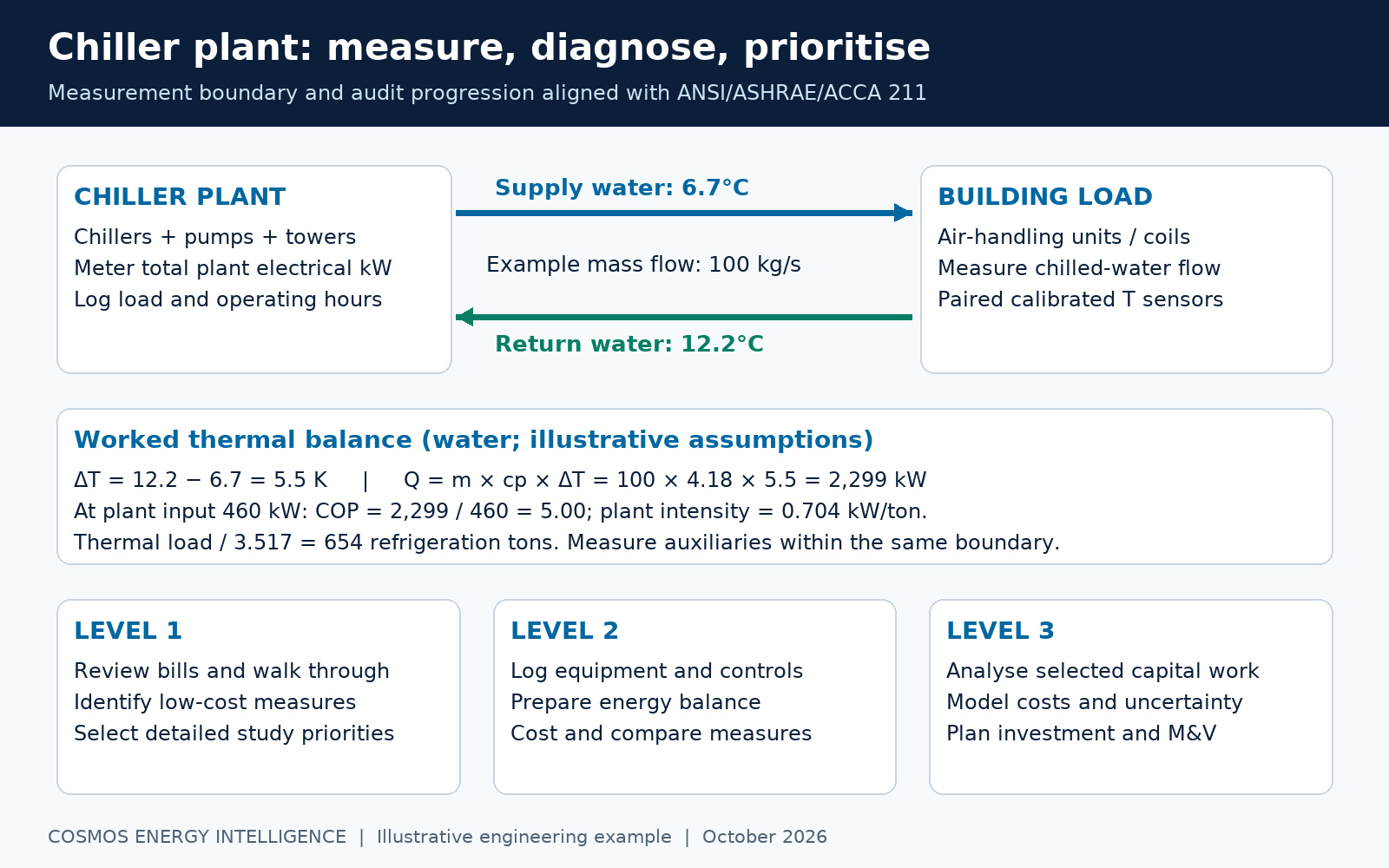
ANSI/ASHRAE/ACCA Standard 211 defines three audit levels. The separate Abu Dhabi DoE M&V Protocol DoE/PD/P04/005 addresses measurement and verification; it does not prescribe savings by audit level.
Audit scope and illustrative planning scenariosView the technical comparison table
| Audit level | Scope | Illustrative HVAC savings | Payback assumption | Decision |
|---|---|---|---|---|
| Level 1: Walk-through analysis | Preliminary energy-use analysis and identification of low-cost operational measures. | 5–10% | Under 6 months (illustrative) | Screen operational measures and select priorities for further analysis. |
| Level 2: Energy survey and analysis | Field measurements, an energy balance, and costed energy conservation measures. | 12–25% | 1–3 years (illustrative) | Compare targeted retrofits using site-specific savings and lifecycle costs. |
| Level 3: Detailed analysis of capital measures | Detailed technical and financial analysis of selected major capital measures, including uncertainty. | 20–35% | Site-specific capital renewal assessment | Evaluate capital renewal options and agree the investment and verification plan. |
These ranges are illustrative feasibility and budgeting assumptions, not measured project results, typical savings, guarantees, or requirements of ASHRAE 211. Audit depth does not determine savings. Each scenario uses the same annual HVAC electricity baseline; ranges are alternatives and must not be added. Confirm savings and payback using site measurements, operating hours, tariffs, implementation costs, and an agreed M&V plan before investment.
4. Phased Retrofit Roadmap Matrix
The definitive outcome of an audit is an investment-prioritized roadmap that prioritizes energy conservation measures (ECMs) by feasibility and verified economics:
Phased Retrofit Roadmap MatrixView the technical comparison table
| Implementation Phase | Time Horizon | Key Interventions & Measures | Capital Outlay | Target Energy Impact |
|---|---|---|---|---|
| Phase 1: Operational Tuning | 0 – 6 Months | Chilled water temperature resets, BMS scheduling corrections, hydronic valve rebalancing, sensor recalibration. | Near Zero / Operational | Site-specific verified operational savings |
| Phase 2: Targeted System Retrofits | 6 – 24 Months | VFD retrofits on secondary chilled water pumps and AHUs, EC plug fan upgrades, digital PICV valve installation, cooling tower sequencing. | Moderate; funding depends on verified economics | Site-specific verified retrofit savings |
| Phase 3: Strategic Modernization | 2 – 5 Years | Chiller replacement with high-efficiency oil-free magnetic-bearing centrifugal units, low-GWP refrigerants, thermal energy storage (TES), rooftop solar PV. | Capital Expenditure | Site-specific verified capital renewal savings |
This structured progression forms the core technical review required for ISO 50001 Energy Management Systems (EnMS), transforming a static audit report into a dynamic continuous improvement loop.
5. Mitigating Low Delta-T Syndrome in GCC District Cooling & Central Plants
One of the most persistent, costly inefficiencies in Gulf commercial facilities is Low Delta-T Syndrome. In chilled water systems designed for a 6°C temperature differential (e.g. 6°C supply and 12°C return), system degradation frequently results in return temperatures of 8.5°C or 9°C—a Delta-T of only 3°C.
Thermodynamically, cooling capacity is governed by Q = m · Cp · ΔT. When Delta-T is halved, twice the volumetric flow of water must be pumped through the network to satisfy identical cooling loads. This cascades into catastrophic operational penalties: chillers are forced to stage on prematurely at partial, inefficient load points, primary and secondary pumps draw excessive electrical power, and district cooling customers incur heavy surcharge fees from utilities.
Our engineering audits diagnose the root causes of Low Delta-T—including improper control valve sizing, 3-way bypass valve leakage, air handler coil fouling, and improper decoupling of primary/secondary hydronic loops—restoring optimal temperature differentials and cutting chiller operating hours.
6. The Leadership Advantage & UAE Net Zero 2050
Optimizing commercial cooling is no longer just about controlling utility bills. It enhances tenant thermal satisfaction, improves net operating income (NOI), increases commercial property capitalization rates, and demonstrates compliance with federal sustainability frameworks including the UAE Net Zero 2050 strategic initiative and Dubai Demand Side Management Strategy 2030.
Because Cosmos Energy Intelligence does not manufacture chillers, sell replacement parts, or accept vendor commissions, our recommendations remain 100% objective, focused exclusively on maximizing client return on investment.