
Protocol reference: EVO IPMVP Core Concepts (EVO 10000-1; the DoE protocol cites the 2016 edition). Use the edition agreed in the project M&V plan.
1. Savings Are Calculated, Not Metered
Across commercial and industrial real estate in Dubai, Abu Dhabi, Riyadh, and Jeddah, substantial capital is committed annually to cooling efficiency retrofits: magnetic-bearing chillers, variable frequency drives (VFDs), smart digital balancing valves, and advanced building management system (BMS) supervisory controls.
For asset owners, chief financial officers, and energy service companies (ESCOs), the decisive question is: How do we legally and indisputably prove the return on investment?
Energy consumption can be directly metered, but avoided energy (savings) represents consumption that did not occur. Avoided energy cannot be read from a physical meter—it must be calculated by comparing post-retrofit consumption against a normalized baseline. If Dubai experiences an unusually severe heatwave or tenant occupancy surges by 30%, raw utility bills will climb even while newly installed chillers operate at peak efficiency. Independent Measurement & Verification (M&V) separates true equipment performance from weather and occupancy variables, turning energy efficiency into a bankable, legally defensible financial asset.
2. The Core IPMVP Savings Equation & Normalized Regression Models
Savings equation and normalized regression modelsView the formula and calculation context
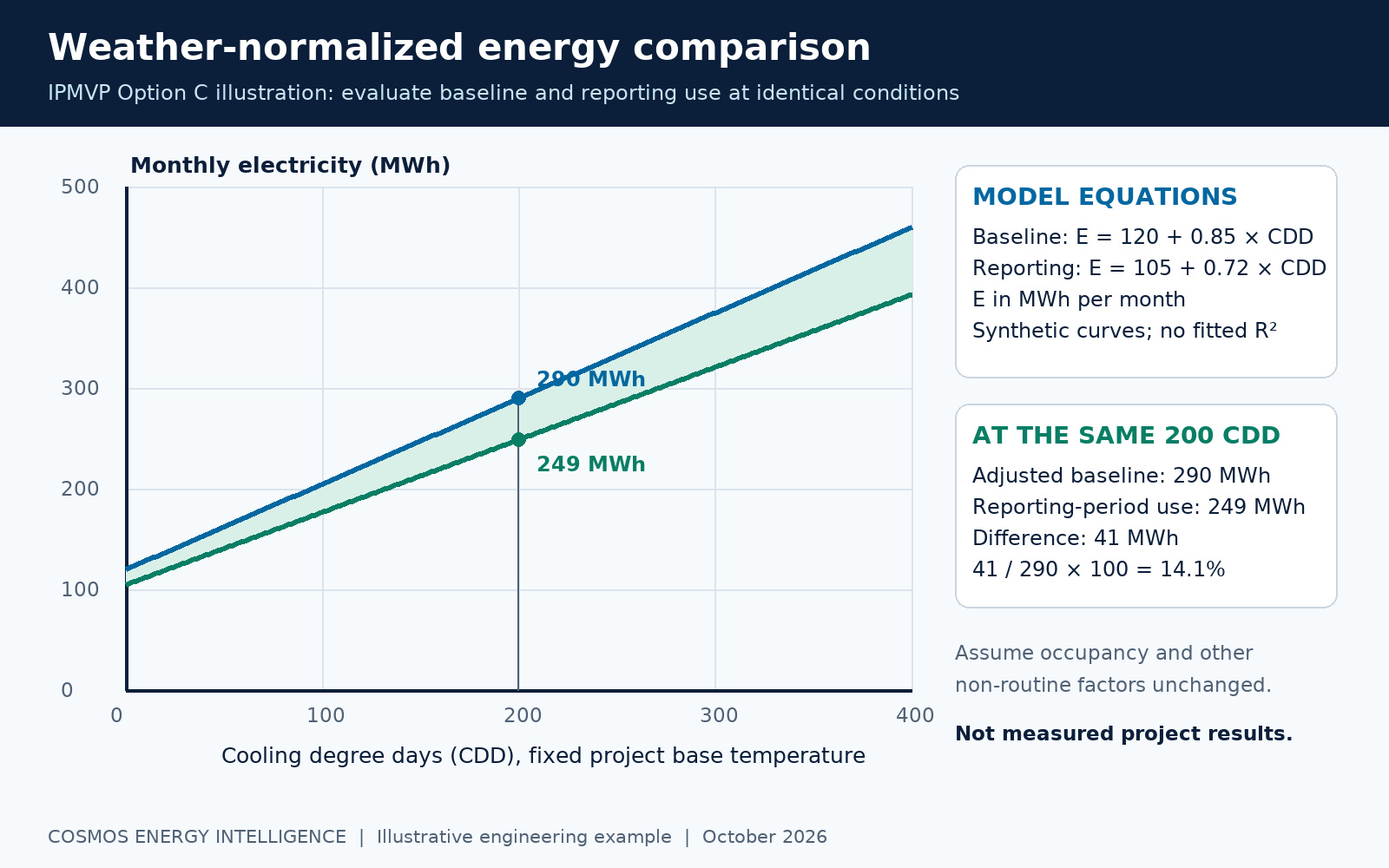
The International Performance Measurement and Verification Protocol (IPMVP, published by the Efficiency Valuation Organization - EVO) governs global M&V practice through the fundamental equation:
To isolate weather and occupancy variables, engineers establish multi-variable linear regression models correlating energy consumption with independent variables:
Under regional regulatory frameworks (such as the Abu Dhabi Department of Energy M&V Protocol and Dubai RSB), regression models must meet strict statistical validation criteria before savings are deemed bankable:
- Coefficient of Determination (R²): Must exceed 0.75, verifying that at least 75% of the variance in energy consumption is explained by independent variables.
- ASHRAE calibrated-model reference: ASHRAE Guideline 14-2023 calibration criteria give CV(RMSE) below 15% for monthly data and below 30% for hourly data. These are calibrated model-fit criteria and do not override jurisdiction-specific regression thresholds.
- t-Statistic on Independent Predictors: Must exceed 2.0 (p < 0.05), proving that Cooling Degree Days and occupancy variables are statistically significant drivers.
3. Executive Comparison Table: The Four IPMVP Options
Selecting the appropriate IPMVP option depends on the retrofit boundary, data availability, and acceptable measurement uncertainty:
Executive Comparison Table: The Four IPMVP OptionsView the technical comparison table
| IPMVP Option | Measurement Boundary | What is Measured vs. Stipulated | Key GCC Applications | Cost & Uncertainty Profile |
|---|---|---|---|---|
| Option A: Partially Measured Isolation | Single component or isolated subsystem | Measured: Key operating parameter (e.g. kW motor power). Stipulated: Operational run hours based on historical schedules. |
LED lighting retrofits, constant-speed ventilation fans, constant-load booster pumps. | Lowest M&V cost (< 2% of project value); moderate uncertainty if run hours change. |
| Option B: All Parameter Isolation | Subsystem boundary (complete central plant or mechanical room) | Measured: Continuous submetering of electrical input (kWh) and thermal output (BTU/TR-hrs via flowmeters and RTDs). Stipulated: None. |
Central chiller plant retrofits, VFD installations on secondary pumps, cooling tower optimization. | Gold standard for cooling (3%–5% of project cost); highest certainty, fully isolated from tenant space changes. |
| Option C: Whole Facility | Entire facility / main utility intake | Measured: Main utility electricity, water, and district cooling billing meters. Stipulated: None; regression models adjust for weather and occupancy. |
Deep retrofits combining mechanical, envelope, lighting, and BMS where cumulative savings exceed 10%–15%. | Cost-effective (1%–3% of project cost); vulnerable to non-routine facility operational changes. |
| Option D: Calibrated Simulation | Whole facility or multi-zone complex | Measured: Calibrated against utility history via dynamic energy simulation software (EnergyPlus, IES VE). Stipulated: Model physics. |
Major capital renewals, gut rehabilitations, new construction where pre-retrofit submetering is unavailable. | Higher engineering modeling cost (5%–10%); essential for complex interactive thermal measures. |
4. GCC Regulatory Compliance Across Dubai, Abu Dhabi, and Saudi Arabia
M&V protocols across the Gulf region are formally embedded into national energy codes and government ESCO accreditation frameworks:
- Dubai Regulatory and Supervisory Bureau (RSB): Oversees the RSB M&V Protocol and ESCO Accreditation Scheme, standardizing guaranteed savings contracts for Etihad ESCO and private developments targeting Dubai 2030 Demand-Side Management goals.
- Abu Dhabi Department of Energy (DoE): Governed by protocol DoE/PD/P04/005 (effective January 2022, built on IPMVP Core Concepts EVO 10000-1). It sets statistical acceptance limits for its regression models, including R² > 0.75 and CV(RMSE) < 0.05. This is protocol-specific; the cited DoE threshold is not qualified by monthly or daily intervals. For context, ASHRAE Guideline 14-2023 calibrated-model criteria use CV(RMSE) below 15% for monthly data and below 30% for hourly data. See the ASHRAE Handbook Chapter 19 and U.S. DOE FEMP M&V Guidelines 5.0.
- Saudi Arabia Tarshid and SEEC: Regulated by the Saudi Energy Efficiency Center under the National M&V User Guide for the Kingdom Version 2. Super-ESCO Tarshid mandates that only certified measurement & verification professionals (CMVP) perform independent third-party savings validation for public and commercial performance contracts.
Interpreting model-fit thresholds
For calibrated energy-model comparisons, ASHRAE Guideline 14-2023 gives CV(RMSE) calibration criteria of less than 15% for monthly data and less than 30% for hourly data. Those values apply to calibrated model fit and do not replace the Abu Dhabi DoE protocol’s separate regression acceptance criteria. The DoE protocol specifies R² greater than 0.75 and CV(RMSE) below 0.05 without a monthly or daily interval qualification in the cited protocol summary.
Sources: Abu Dhabi DoE Protocol DoE/PD/P04/005; ASHRAE Handbook, Chapter 19; U.S. DOE FEMP M&V Guidelines 5.0, Table 4-2.
5. Three Critical Gulf Engineering Considerations
- Chilled Water Delta-T & Sensor Accuracy: Narrow temperature differentials amplify measurement error. In a 4°C Delta-T system, a sensor pair error of 0.2°C translates to a 5% error in calculated ton-hours. Regional metering standards require high-precision matched 4-wire Pt100 or Pt1000 Resistance Temperature Detectors (RTDs) calibrated to Class A tolerance (±0.05°C).
- Degree Day Base Calibration (Wet Bulb vs. Dry Bulb): In humid coastal Gulf climates (Dubai Marina, Abu Dhabi Corniche, Doha West Bay), cooling tower heat rejection and outdoor air enthalpy correlate far more closely with wet-bulb temperature than dry-bulb. M&V regression models must evaluate wet-bulb degree days to prevent underestimating savings during humid summer periods.
- Tariff Structure Separation: Calculate energy savings in physical engineering units (kilowatt-hours, refrigeration ton-hours, cubic meters) first. Apply utility tariffs and fuel adjustment surcharges separately to protect the engineering performance integrity against utility tariff escalations.